

How our AI is governed
Source checks, controlled workflows and their boundaries.
Read the governance approachAITrust · AI evaluation
No model or agent is put into use without passing its evaluation.
How our AI is governedThe gate is in the database, not a checklist. A model can only be bound to a task if it names a passing evaluation run for that model and task, and a newer failed run blocks it. Agents follow the same rule before they can be activated.
A model is bound to a task only with a passing run for that same model and task.
If a later run of that model on that task failed, the binding is refused until a newer run passes.
An agent cannot be activated without a passing run for its current version.
Returning to an earlier model goes back through the same gate.
A single error rate hides what matters. We rank errors by clinical severity. An invented or unsupported medicine, dose, allergy, vital sign or diagnosis fails the run outright, however good the rest of the note is.
A moved sentence and a wrong allergy count the same in an average.
A note that says almost nothing says almost nothing wrong.
The same score from ten cases and from a thousand means different things.
A model grading its own work shares its own blind spots.
Omission is scored alongside faithfulness, so a model cannot pass by writing less. A note that says nothing wrong but leaves out what matters still fails.
Results are reported with 95% confidence intervals, never as a bare percentage, and repeated runs show whether a result holds. A grading model cannot be the model being tested.
Test suites carry adversarial cases: text that tries to give the AI instructions. A suite that declares this check without such cases fails. Transcripts and documents are treated as data, never as instructions.
Testing is not the last line. In the consultation, every medicine and dose is checked against the source; anything unsupported is held for review with a safety note. The clinician accepts, edits or rejects each suggestion; there is no accept-all.
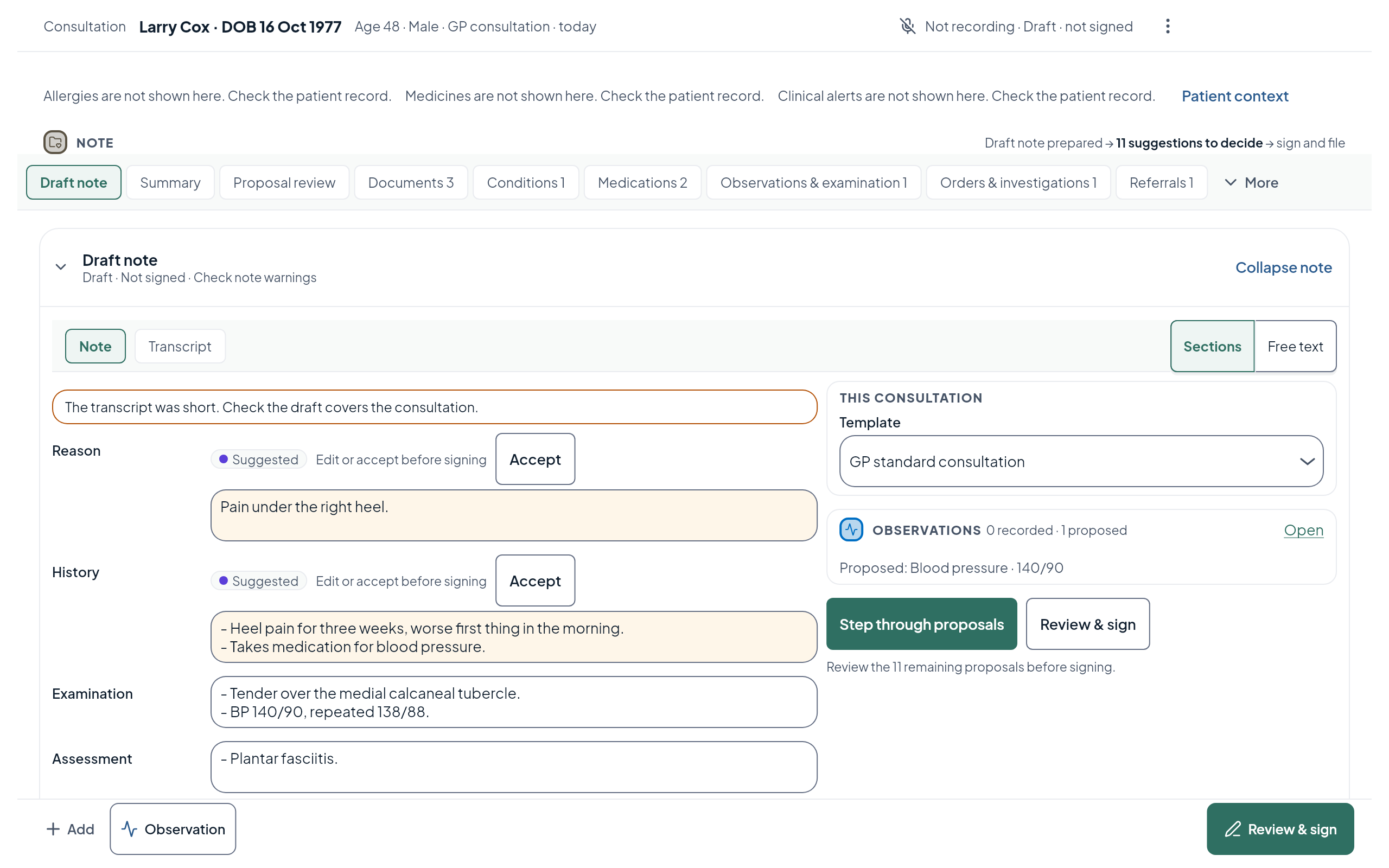
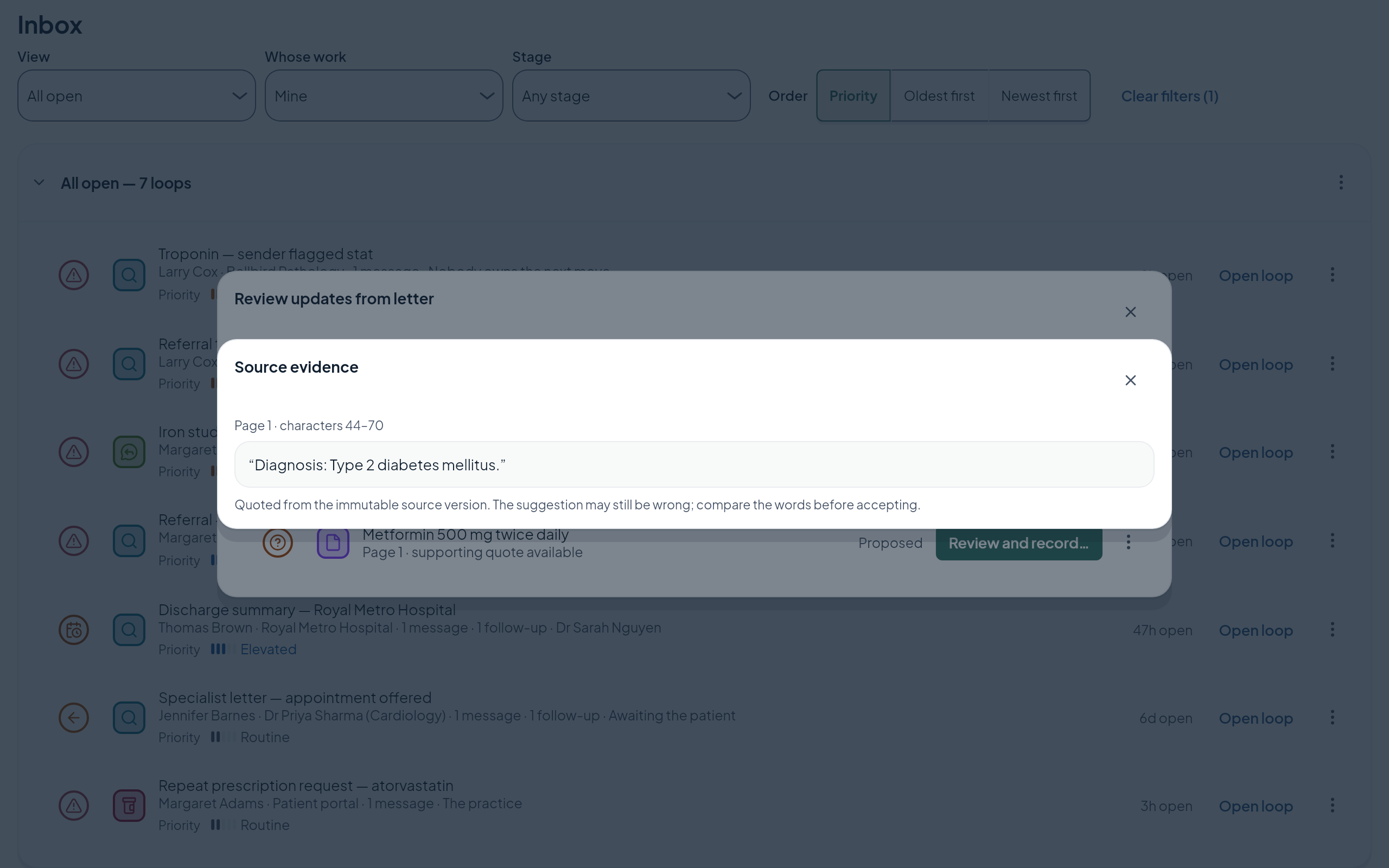
After release, grounding-review rate, clinician acceptance, feedback, evaluation hallucination rate and changes in the input mix are tracked, each compared with the previous period. Hazards are recorded in a hazard log, and any rollback goes back through the evaluation gate.
A pass is evidence, with limits. We say exactly what it covers.
Where things stand
Echo One is coming soon. The evaluation method, the release gate and the checks on this page are built into the product, and apply to every model and agent before it is used.
Every model and agent passes through it before use, and again on rollback.
Enforced by the database beneath the software that changes models.
Tracked after release and compared with the previous period.
The clinician decides on each suggestion, one at a time.
Counts of rules and checks, not performance figures.
Source checks, controlled workflows and their boundaries.
Read the governance approachConsent, review and accountability.
Read the clinical approachPlatform, website and service obligations, kept distinct.
Read about complianceThis page as a short slide guide to download and share.
Get the guideRegistering interest is not a commitment to purchase.
Join the waiting list